Our Adcolors Audience Engine is the research process we run before any production begins. We analyze your audience, category, and messaging to define a clear campaign direction.
Our Adcolors Audience Engine is the research process we run before any production begins. We analyze your audience, category, and messaging to define a clear campaign direction.

The UFC’s audience and this product’s buyer are not the same person. Here’s what the research shows.
Before narrowing to a primary audience, we mapped every segment in the category — their motivations, retention profiles, and economic value. The data pointed clearly in one direction.
Nutrition as identity. Tracks macros, trains consistently, buys into the discipline. Highest retention of any segment — the purchase reinforces who he believes he is. Responds to the UFC PI credential and will pay for genuine performance nutrition. Of all four segments, this buyer is the most likely to stay, the most likely to be moved by the brand’s unique credibility, and the most aligned with what UFC Ignite actually is.
Biggest segment in the category by volume, but driven by convenience rather than performance identity. Research shows 50% cancel within the first month, with only 20% staying past 6 months. Will respond to the product, but the UFC PI narrative is unlikely to be the retention driver for this buyer — price and friction are.
Brand affinity drives trial — “eating what the fighters eat” is the appeal. Income skews lower (60% under $50K) vs. the typical meal delivery buyer, and documented skepticism from the MMA community is a headwind. High trial potential, but enthusiasm at purchase tends not to sustain the subscription.
Seasonal, discount-driven, lowest retention in the category. The 50% first-order promo naturally attracts this buyer. The challenge is retention — this segment tends to churn when the promotional period ends, which means acquisition cost is rarely recovered. Creative built for the Fitness-Identity buyer tends to produce subscribers who stay longer.
28–42. Trains consistently. Tracks macros. Spends more on fitness than almost any other consumer group. Of all four segments, this buyer has the highest retention, the strongest alignment with UFC Ignite’s credibility, and the clearest gap between what he needs and what the market currently offers him.
A disciplined optimizer. Fitness isn’t a hobby — it’s infrastructure. He tracks macros, manages training cycles, and reads the science before buying a supplement. He’s not trying to look good for the beach. He’s building something.
Consistency over intensity. Evidence over enthusiasm. He’s post-hustle culture — “train for life” has replaced “beast mode.” He trusts brands that respect his intelligence enough to show their work. He distrusts brands that lead with energy and skip the data.
YouTube-first: Renaissance Periodization, Muscle & Strength, Tiger Fitness. Reddit-adjacent: r/Fitness (12.5M members), r/nutrition, r/bodybuilding. He researches before he buys. The content he trusts most is evidence-based — which is exactly what the UFC Performance Institute is built on.
Unfiltered. These are the words the campaign needs to reflect back.
“All protein packed and they’re actually the same meals that are made for the athletes in the UFC. All I did was follow the instructions…”
“[Factor] is fine but it’s just… food. There’s nothing that makes me feel like I’m actually fueling for anything.”
“Macros matter more than calories for my goals — I don’t care what the calorie count is, just tell me the protein.”
“I’ve been eating [competitor] for 3 years and finally giving up… the quality just isn’t consistent enough to justify the price anymore.”
Millennial men are the most emotionally receptive demographic in video advertising — but only for brands that see them clearly. Aspirational-authentic wins. Pure polish loses.
Gym-adjacent spaces, apartments, post-workout contexts, the car at 6pm. Factor already owns the “clean kitchen staging” aesthetic — that lane is taken. UFC Ignite needs to live where this buyer actually exists. The UFC PI setting is powerful when used sparingly as a credibility signal, not as a default backdrop.
The casting bar is “your training partner” — not your hero. Someone the viewer recognizes from the gym, not from a magazine cover. Diverse casting is both accurate to the UFC audience demographic and strategically correct. Every person on screen should feel earned, not selected.
On-screen protein grams, prep time, and calorie counts function as both information and scroll-stopping visuals. “30G PROTEIN. FOUR MINUTES.” This pattern performs well for this audience because it signals respect for their intelligence. Fuel Meals’ execution demonstrates the approach — UFC Ignite can do it at higher production quality.
High-quality production with an unscripted feel. The sweet spot is documentary-quality imagery in real contexts — agile, observational, honest. This audience’s authenticity radar is calibrated. They can tell the difference between a brand that’s trying to look real and content that actually is.
Channel order is based on where this audience lives, how they consume content, and what the platform data says about attention and fit — not production cost or convention.
This audience is on YouTube consuming performance fitness content from Renaissance Periodization, Muscle & Strength, and Tiger Fitness — the exact channels where your pre-roll runs. Sound-on, leaned in, non-skippable. The audience isn’t scrolling — they’re watching. This is where the UFC PI credibility narrative earns its room to breathe. The :30s and :60s (Option B) are the primary assets here.
CTV delivers the highest attention scores of any digital format — 1.5–3× higher than standard online video. This audience is leaned in, sound-on, and not scrolling past anything. The UFC CBS deal makes this directly relevant: the March 2026 debut drew 2.47M viewers, strongest in 18–34 (+208%) and 18–49 (+190%) — exactly the buyer this campaign targets. Sports-adjacent CTV inventory around UFC events commands $30–$50+ CPM because the audience is paying full attention. The :30s primary and :60s (Option B) are built for this environment from the start — horizontal, sound-on, structured to earn the non-skip. Media buying is handled by your team or a buying partner; the production assets are ready.
The conversion and retargeting layer. Reels deliver the lowest CPM of Instagram placements while maintaining strong reach for this cohort. The sound-off cut with macro callouts and hook variations live here — the hook testing system lets the media buyer find which specific opening stops the scroll for this audience. The buyer reached on YouTube or CTV gets followed into Meta with a shorter, direct-response cut.
Present and significantly underleveraged by competitors. Factor and Trifecta both have minimal TikTok-native content — there’s a clear opening for a brand willing to produce authentic native content. The 9:16 vertical cut from either production option runs here at low incremental cost. Fighter content (Option B) produces natural TikTok material — fight-week nutrition, meal reveals, behind-the-scenes PI access — exactly what this platform amplifies organically.
The Fitness-Identity buyer is in-market year-round — unlike the New Year/Goal-Resetter segment, his purchase trigger isn’t seasonal. Highest intent aligns with UFC broadcast events on CBS, where second-screen behavior during live sports (57–77% of viewers use a second screen) creates a social and mobile retargeting opportunity at lower CPMs. The UFC’s CBS debut in March 2026 drew 2.47M viewers, strongest in 18–34 (+208%) and 18–49 (+190%) demographics — exactly the cohort you’re building for.
Real middle-aged former athletes, not professionals. Identity recognition over aspiration.
Found middle-aged former high school athletes and let them replay their championship game — a real production, real stakes, real outcomes. No models, no professionals. Real people in the athletic identity they still believed they carried.
It spoke to who the audience believed they still were, not who they used to be. Athletic identity doesn’t expire. The campaign proved it, rather than asserting it. The audience saw themselves — not an aspirational proxy.
This buyer still thinks of himself as an athlete, even if he’s training at 6am before work. The creative should treat him that way — not inspire him to become something, but recognize what he already is.
Repositioned around movement as joy, not performance metrics. Brand that sees who you are.
Moved Puma away from sports performance metrics toward the primal joy of movement. Identity-driven casting, emotional reframing — not “perform better,” but “remember why you move.” The brand stopped selling a product and started recognizing a feeling.
Connected the product to a feeling the audience already had, then credited the brand for unlocking it. Didn’t sell performance credentials. Sold identity recognition. The audience felt seen, not pitched.
UFC Ignite doesn’t need to prove it’s a performance product — it needs to prove it sees this buyer clearly. The UFC PI provides the credential. The creative provides the recognition. Different jobs.
“Not your average athlete.” Functional claims, diverse casting, real training contexts.
Built their largest campaign around real athletes — diverse representation, functional performance claims, training contexts that felt earned rather than staged. Used sports credibility without celebrity dependency.
The audience that uses sports drinks for training (not fans watching sports) responded to seeing themselves rather than their heroes. Functional specificity — what the product actually does, stated plainly — earned the trust that aspirational copy wouldn’t.
UFC fighter content in UFC Ignite’s creative serves the PI credibility angle, not the fan-identification angle. The fighters are evidence of the product’s standard. Not the aspiration — the proof.
The PI is scientific authority. The UFC brand is the door opener. Every piece of creative should make this distinction clear. Conflating them produces the “cash grab” read that the MMA community has already attached to the brand — and that the fitness-identity buyer is primed to agree with.
This audience is heavily active on social platforms where sound-off viewing is standard, per SparkToro data. Captions, bold text overlays, and macro callouts on screen tend to significantly improve performance in these environments. Sound-off is not a stylistic choice — it’s where a large portion of digital video impressions are delivered.
Nielsen research confirms millennial men over-index on content that recognizes who they actually are — a 37-point brand equity lift when advertising gets this right. Real, training-adjacent, diverse casting signals that the brand sees this buyer clearly. Aspirational model or celebrity casting tends to create distance rather than connection with this cohort.
A macro claim, a time claim, a performance standard in the first three seconds. Research on hook performance shows this audience responds to functional specificity — it signals respect for their intelligence. Fuel Meals’ “54G IN ONE BURGER?!” demonstrates the pattern working at smaller scale; UFC Ignite has greater institutional authority behind the same approach.
Two worlds that prove the same thing from different angles. The fighter content establishes the standard. The everyday guy demonstrates the extension. Run together or in sequence, they make the institutional credibility claim concrete rather than asserted.
Not just implied by product benefit. “You’ve already done the hard part. This is what the discipline looks like when life doesn’t give you four hours.” This buyer wants permission, not inspiration — making the permission structure the explicit story tends to resonate with buyers who identify as disciplined but face real time constraints.
Protein grams, prep time, calorie count as animated text overlays. Tends to perform for this audience because it signals both transparency and respect for their sophistication. Works in both sound-on and sound-off environments, which makes it efficient across the full channel mix.
1.4 million people now have a formed negative opinion about a product they never would have sought out on their own. The comment section is permanent, indexed, and encountered by every potential subscriber who does any due diligence before signing up.
The negative response isn’t random. Three consistent patterns point directly to an audience mismatch — not a product problem.
This is not a product problem. The response pattern is entirely explained by audience mismatch. Two fundamentally different people — one who saw the spot, one it was built for.
| The Audience Who Saw It | The Audience It Was Built For |
|---|---|
| Follows fighters, watches every card | Works out consistently, tracks macros |
| Cooks chicken and rice — proud of it | Wants the nutrition shortcut without the guilt |
| Sees meal delivery as lazy and expensive | Sees meal delivery as a discipline tool |
| Primed to see UFC extensions as cash grabs | No UFC brand baggage — responds to PI credibility |
| Income skews lower — price is an immediate objection | Income skews higher — pays for quality and precision |
To the MMA fan, that reads as: another UFC product. To the fitness-nutrition buyer — who was never reached — the UFC Performance Institute is a genuinely compelling credential: the same nutrition science that trains professional fighters, available to you. The most powerful thing about UFC Ignite was buried. The thing most likely to generate cynicism was featured.
The spot has been live since January 9, 2026. It is the first result when someone searches UFC Ignite on YouTube. Every potential subscriber who does any due diligence before signing up encounters 82% negative comments, a 90% dislike ratio, and reviews including “I tried these and they were terrible.” That is the brand’s current public face.
Four consistent signals across the full research pipeline.
SparkToro data confirms this audience over-indexes on evidence-based resources — Examine.com, Stronger By Science, RP Strength. They are research-first buyers who respond to institutional authority, not brand association. The PI credential speaks directly to that. To the fitness-nutrition buyer, “the nutrition system behind UFC’s elite fighters” is a performance credential. “UFC has a meal service” is a brand extension. They respond to one and distrust the other.
This buyer makes evidence-based purchasing decisions. The visual treatment is evidence. A production level that doesn’t match the UFC PI claim creates a credibility gap before the offer registers. Competitors Factor and Trifecta are running polished multi-platform creative. The production bar is set by the category and by the brand’s own positioning — not by the brief.
Nielsen research documents a 37-point brand equity lift when millennial men see advertising that reflects who they actually are rather than who they aspire to be. Fighter-led creative signals: this is a UFC product. Real, training-adjacent talent signals: this brand understands my world. The viewer wants to be seen, not inspired by someone else’s athletic achievement.
The creative insight the research points to: this buyer takes his training seriously, knows nutrition matters, and doesn’t always have time to do it right. The spot that resonates makes him feel seen in that specific tension — not inspired by someone else’s performance. SparkToro confirms the audience over-indexes on evidence-based content, not motivational or combat-sport content. The emotional register that converts is precision and quiet confidence, not intensity.
Cheap test commercials are the right call in a lot of situations. Four conditions determine when a low-budget test produces actionable data — and when it produces a second public miss under the brand name.
The claim is prestige-based and requires visual proof. The brand already has a public data point with a 90% dislike ratio. The target buyer is research-oriented and skeptical. The competitive category has a visible production quality floor. In those four conditions specifically, a cheap test doesn’t produce actionable data — it produces a second public miss under the UFC name.
A $7,500 test commercial feels like a responsible business decision. Here’s what the math actually looks like for UFC Ignite specifically.
The existing YouTube spot has 1,438,836 views and a 90% dislike ratio. It is still live. Reputation management and brand repair at that scale — suppressing negative search results, rebuilding trust with a skeptical audience — costs significantly more than any production budget and takes sustained quality creative over an extended period. Every additional low-quality asset adds to that repair bill. Every piece of quality content works against it.
Each one reached the right person. Each one proved what happens when the execution earns belief.
63% regional sales lift. $3M+ earned media from $225K paid. A 15,000-seat stadium sold out in 90 minutes.
Gatorade staged the rematch of a 1993 high school football game that ended in a 7–7 tie. The original players — now in their 30s — underwent a 10-week Gatorade-guided training and nutrition program before playing in a televised event. The product’s performance claims were embedded in a real story with real people.
Gatorade’s buyer wasn’t a professional athlete — he was someone who once competed and still identified with athletic performance. The insight: regular people who take their performance seriously deserve the same nutrition system as champions. That’s precisely the UFC Ignite fitness-nutrition buyer. When executed with production quality that earns belief, it converts.
The result was 581 million media impressions and multiple subsequent seasons on FOX Sports. The production matched the credibility claim. The claim earned belief. The buyer responded at scale.
107 million total views. 10.2 million YouTube views in month one. Measurable favorability increase among Gen Z.
PUMA needed to reconnect with a fitness audience that had drifted toward Nike and Adidas. Rather than leading with product features or athlete endorsements, they built a global campaign around a single emotional truth: the specific feeling runners already know but never see reflected in advertising. PUMA increased marketing spend 40% versus the prior year to fund it properly.
The hero film contained no product-centric messaging — it was a pure emotional reframe of what it means to run. By PUMA’s own account, the most significant brand marketing investment in their history was the one that moved the needle.
Find the one feeling your product produces that your audience has already experienced but never seen reflected back at them. The fitness-nutrition buyer knows the feeling of having his food handled correctly on a hard training day. He’s never seen it in a meal delivery ad. That’s the territory. PUMA proves that when you find it and execute it with production quality that earns belief, the audience responds at scale.
$225M earned media. 6x higher CTR than previous campaigns. App sessions grew 3x quarter-over-quarter.
Uber Eats identified a cultural truth hiding in plain sight — football is already full of food language (“turnovers,” “the spread,” “scrambles”). They built a season-long campaign around that insight with Bradley Cooper as the lead, running across NBC Sunday Night Football, CTV, social, and earned media throughout the entire NFL calendar.
The structural parallel to UFC Ignite is direct. UFC now airs on CBS and Paramount+ with 2.47 million viewers at debut — the strongest 18–34 and 18–49 ratings in the network’s recent history. Uber Eats turned NFL broadcasts into a sustained food marketing platform by finding the cultural truth connecting sport and product. All featured food partners reported record sales weeks.
UFC events are already full of nutrition language — cutting weight, walking weight, fight-week diet, making weight. A campaign built around that insight — executed at production quality that earns the broadcast environment — is the Uber Eats model applied to combat sports. It didn’t work because of the budget. It worked because the insight was real and the execution matched the ambition.
Four conclusions from the full audience and creative analysis. Each one shapes what the next spot needs to do.
The UFC’s existing audience and this product’s buyer are not the same person. The Fitness-Identity buyer — who tracks macros, trains consistently, and views nutrition as part of his discipline — is where the retention data points. Creative built for him earns the subscription. Creative built for the MMA fan doesn’t.
The UFC Performance Institute is a genuine performance credential. “The nutrition system behind UFC’s elite fighters” speaks directly to the evidence-first buyer the research identifies. “UFC has a meal service” reads as a brand extension — and this audience has seen enough of those to be skeptical by default.
This buyer doesn’t need motivation. He’s already doing the work. The creative territory the research points to is earned relief — the moment after a hard training day when the nutrition is already handled and it’s exactly right. He wants to be seen, not inspired by someone else’s performance.
The UFC Performance Institute claim sets a standard. The visual execution is the first piece of evidence for or against it. A production level that doesn’t match the claim creates a credibility gap before the offer registers — the first spot proved this. The production bar is set by the brand’s own positioning, not by the brief.
“Engineered by the UFC Performance Institute” is being deployed as a trust shortcut for an audience that has no existing trust to shortcut to. The current creative assumes the buyer knows what the PI is, respects what it does, and transfers that respect to UFC Ignite automatically. None of those assumptions are valid. The next spot can’t cite the PI and move on — it has to introduce the PI as a concept. Briefly. Credibly. In a way that makes this buyer think: I didn’t know that existed. And now I want what those athletes have.
No competitor has access to this credential. Factor can’t claim it. Trifecta lost it when their UFC partnership ended. The PI is the moat. The current creative doesn’t know how to use it yet.
The audience is identified. The credibility gap is documented. The creative territory is mapped. What comes next is production built on all of it — aimed at the right person, leading with the right credential, executed at the standard the brand’s own positioning demands.
The research is done. The strategy is clear. The creative territory is wide open and exclusively yours. What’s left is making the work that proves it.
A practiced process. Nothing moves without your approval at every stage.
Once we’re under agreement, we develop the creative concepts together. This is a collaboration — not a presentation. Your team’s knowledge of the brand and our research inform the creative direction jointly.
Once the creative direction is set, we move into scripting and storyboards. The vision goes on paper before anything goes in front of a camera.
Nothing moves forward without your sign-off. You see and approve the script, the boards, the casting direction, and each cut in post before it becomes final. You’re in the process — not waiting at the end of it.
We work in three installments. The first is a deposit of roughly one-third of production — this establishes the production calendar and puts the full pre-production process in motion: casting, locations, logistics, and shoot scheduling.
The second installment is due at the start of filming. Pre-production is complete, the team is locked, and everything is in place. This is the moment the work moves from planning to making.
The final installment is due only after you have seen and approved the deliverables. You don’t pay the final balance until the work is done and you’re satisfied with it.
On pricing: Final numbers are set during the concepting stage — because cost is driven by the complexity of the creative direction, not by a fixed menu. The ranges in this presentation reflect what a production of this scope typically costs. The exact number is confirmed once we know exactly what we’re making.
This strategy presentation was prepared for UFC Ignite by Adcolors based on independent audience research, SparkToro behavioral data, and competitive analysis of the fitness meal delivery category.
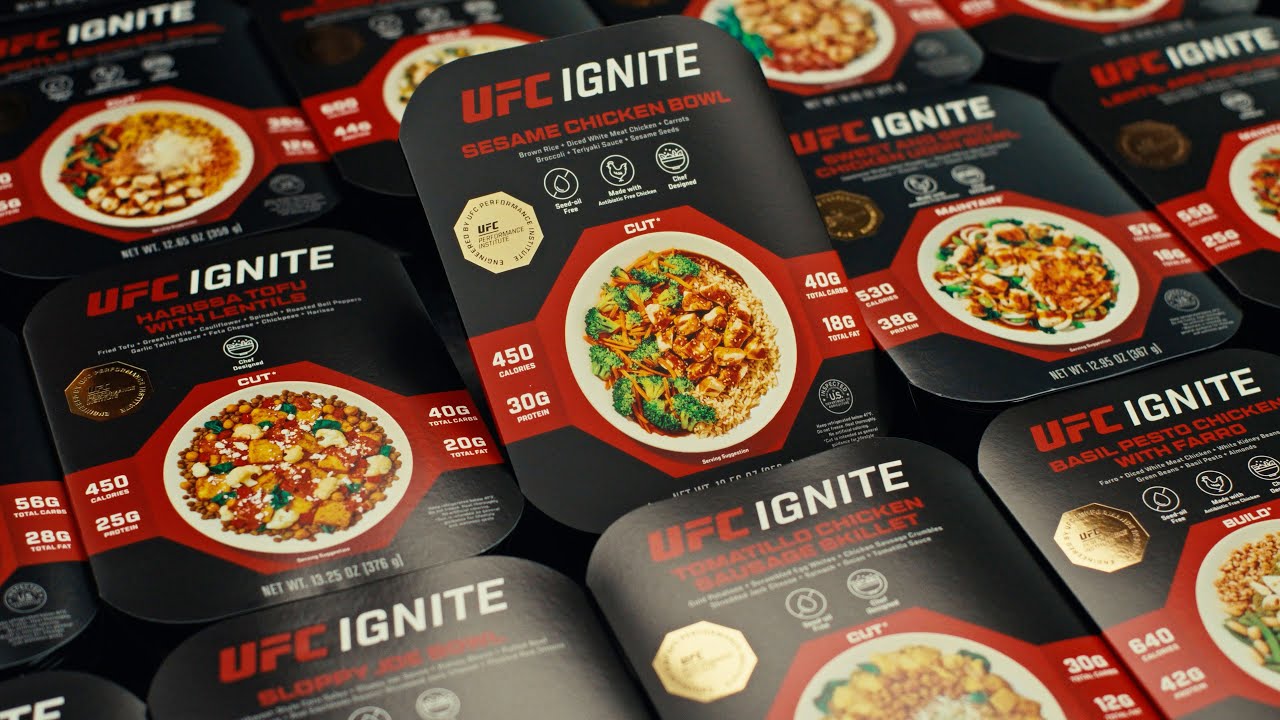
UFC Ignite is a weekly subscription meal delivery program engineered by the UFC Performance Institute and operated by FreshRealm — delivering chef-designed, performance-driven meals directly to consumers’ doorsteps.